Posts

Showing posts with the label online Threats

The enduring challenge of justice: promoting fair trials and accountability through the Media Freedom Coalition.

Image
  Tuesday, 6 th  May 2025; Arrival and networking (tea and coffee provided):  1330 – 1400; Presentation and Panel Discussion:  1400 – 1530. Location:  Egmont Palace, Brussels, Belgium. Journalists should be able to rely on the law to protect them against threats and attacks – but increasingly, laws are being used to suppress independent journalism, including laws that have little to do with freedom of expression. Building on the ongoing work of the Media Freedom Coalition, a partnership of governments that promotes media freedom alongside civil society organisations, a panel of legal experts, and UNESCO, this session will ask: how can governments and other actors promote accountability for crimes against journalists, and fair trials when journalists themselves are charged with crimes? The session will feature case studies of initiatives such as trial monitoring by embassy representatives, recent research into a proposed international task force to investigate c...

SILENCED - Democracy, Journalism and Censorship in the Digital Age.

Image
The vital role of a vibrant, #FreePress in preserving the #RuleOfLaw cannot be overstated The UNESCO & the IBAHRI organised this session to discuss the role of international law in finding solutions to the use of sophisticated spyware products to target specific actors.

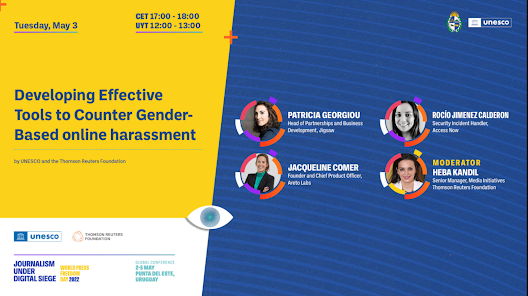
Developing Effective tools to counter Gender-based online harassment.

Image
#Violence against women journalists is surging on and off-line to discredit or silence them; This abuse has also weaponized to undercut public trust. Is this harassment limited, What more needs to be done?

Ending impunity was one of the main challenges.

Image
  In 2021, MapMF documented 12 alerts for Montenegro with 16 attacked persons or entities related to the media. Following a trend across Europe, a vast majority of these attacks (11) were perpetrated by private individuals. Male and female professionals were equally affected. Political as well as nationalist polarisa‐ tion are blatant in Montenegro through a number of alerts. In the case of a reporting team from the public broadcaster Radio-television (RTV), a right-wing nationalist group intimidated and insulted the journalists near the coastal town of Budva. For several weeks, the nationalist group had organised numerous protests over changes to the Law on Citizenship, which would grant Montenegrin citizenship to Russian and Serbian citizens living in the country. The attacked journalists had been caught up in one of their blockades. During another political event in the city of Niksic, on the night of local elections, Vijesti journalist Jelena Jovanović was attacked by an agg...

Verbal attacks, intimidation, online harassment, and legal threats are the main issues affecting journalists.

Image
  Serbia is the candidate country with the second highest number of alerts , following Turkey. In total, 35 attacks affecting 55 persons or entities related to media were registered in the reporting period. As evidenced by the MFRR fact-finding mission organised in January and February 2021, media professionals continue to operate in a highly polarised environment. The data confirms the findings of the mission report , published in April 2021. Verbal attacks, intimidation, online harassment, and legal threats are the main issues affecting journalists in the country.  The country's political and ethnic polarisation is reflected in attacks against journalists who critically report on the ruling Serbian Progessive Party (SNS or President Vucic’s family .arious cases show that radical nationalism endangers the safety of journalist s. Pro-government media were the source of – or incited – attacks against journalists in five cases, for instance by discrediting critical media out...